
Allison Feldman was found dead in her Scottsdale home in 2015.

How familial DNA led to conviction in Arizona woman’s violent murder
20/20 ’Home Alone’ airs Oct. 2nd on ABCA 31-year-old woman murdered in her own home. A city in fear. Over 100 potential suspects. Who was the killer? 20/20 ‘Home Alone’ airs Oct. 2nd at 9/8c on ABC Network. Stream on Disney+ and Hulu.
Allison Feldman returned to her Arizona home after running errands on a typical Tuesday on Feb. 17, 2015. But when the 31-year-old’s family and boyfriend did not hear from her later that evening into the following day, they knew something was wrong.
“We talked almost every day,” her father, Harley Feldman, told local ABC affiliate reporters. “My wife said, it’s just not right, things were out of normal.”
Concerned for his daughter, Harley called Scottsdale Police for a welfare check on her.
At the same time, unbeknownst to Harley, Feldman’s boyfriend, Alex Stone, went to her house in Scottsdale and found her dead on the floor, naked and bloodied.
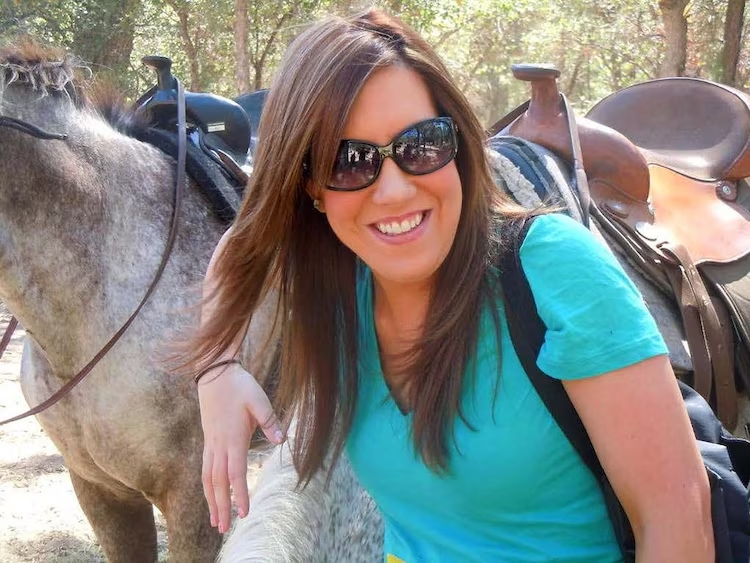
Allison Feldman, 31, was murdered in her home on Feb. 17, 2015.
Courtesy of Kelly Weinblatt
The hunt for Feldman’s killer proceeded for three years until investigators employed a forensic tool never before used in the state’s history. But the battle to use that DNA match went on for several more years.
A new “20/20” episode, “Home Alone,” airing Friday, Oct. 2 at 9 p.m. ET on ABC and streaming the next day on Disney+ and Hulu, examines Allison’s tragic case.
You can get more behind the scenes of each week’s episode by listening to “20/20: The After Show” weekly series right on your 20/20 podcast feed on Mondays, hosted by “20/20” co-anchor Deborah Roberts.
Feldman, originally from Minneapolis, Minnesota, attended the University of Arizona in Tucson for college and remained in the state after graduating. She worked in medical sales specializing in wound and burn care products.
Family, friends and colleagues described Feldman as an amazing woman — unconditionally accepting, active in her community, joyful, fun and compassionate.
Related
How police solved a Massachusetts student’s 1986 murder
“She approached all of the children and everyone really in her life equally the same. Really remarkable young woman,” Nan McCoy, former CEO of Camp Courage, a camp where Feldman worked to help children who had been burned, told “20/20” correspondent John Quiñones.
When Stone discovered his girlfriend’s unresponsive body on Feb. 18, 2015, he called 911, screaming and crying for help.
Evidence at the crime scene led investigators to believe there had likely been a struggle between Feldman and her killer leading up her death, suggesting that Feldman had fought hard.
Allison Feldman was found dead in her home on Feb. 18, 2015.
Courtesy of Scottsdale Police Department
Investigators determined the cause of death was strangulation and loss of blood due to blunt force injuries.
Investigators said the killer had attempted to destroy evidence at the crime scene using chemicals — possibly some type of bleach. DNA evidence found in a stain on the floor and elsewhere in the house represented investigators’ best hope in identifying the person responsible for Feldman’s death, according to authorities. The DNA was connected to an unidentified male — someone not in the police’s records.
John Quiñones, “20/20” correspondent, spoke with investigators and loved ones about the case.
ABC News
Stone was investigators’ first person of interest, but he was cleared when his DNA was not found to match and he showed no signs of injury from a possible struggle, nor did he smell of bleach.
Police canvassed the neighborhood and began collecting DNA samples from neighbors and all of the men known to be in Feldman’s life, including friends and coworkers she interacted with.
None of the samples matched the DNA profile found at the crime scene and the case soon grew cold. Feldman’s father Harley kept in touch with Scottsdale police, never giving up hope that it would be solved.
During a 2016 trip abroad, family members coincidentally met a former Arizona state senator who mentioned the possibility of using a forensic technique called familial DNA. Instead of an exact match, they are looking for a close match to a relative who may already be known to authorities.
The former lawmaker urged Arizona’s attorney general to review state laws to determine whether investigators could use familial DNA in their efforts to find Feldman’s killer. He agreed and for the first time in Arizona history, familial DNA was employed to help solve a criminal case.